Recommendations for the Use of Sherpa Ladders

In those jobs that require the use of manual ladders, it is necessary to take into account a series of instructions and recommendations in order to guarantee safety. For this reason, Sherpa has a risk guide to prevent improper use and to be able to use this type of material in the correct way.

Here are a few examples.

recomendaciones-uso-escaleras-sherpa

Minimums of the risk guide

As ladders must be strong enough to be safe to use, they must conform to EN 131 standards, which provide a guarantee of quality and safety.

For work requiring effort, in unfavourable weather conditions, with reduced visibility or other hazards, the use of other elements such as scaffolding or mobile platforms is recommended.

Having established these two bases, we can go on to establish the following recommendations.

escaleras-andamios-sherpa

General advice on the use of ladders

  • Ladders should be placed at an angle of approximately 75 degrees to the horizontal. The orange label should be used. When ladders are used to access elevated areas, the ladder’s crossbars must extend at least 1 metre above the ladder.
  • The transport and handling of loads on or from ladders is prohibited when their weights or dimensions may compromise safety, never exceeding 150 kg total weight.
  • During the use of ladders, the body shall always be kept inside the ladder stiles and shall not be used by two or more persons simultaneously.
  • The straps and tensioners on stepladders must always be fully extended.
escalera-sherpa
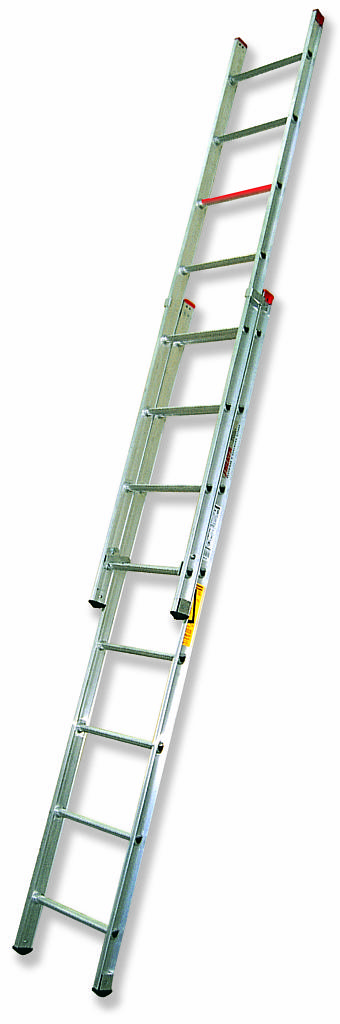
  • When working with extension ladders, the working height must be adjusted and safety devices must be securely fastened.
  • Ensure that the ladder is stable before use. The base must be firmly seated on the ground, always by means of the stiles and never by means of the lower rung.
  • The height of the ladder must not be increased by means of unstable or mobile elements, such as boxes.
  • Secure the top support to trees, lampposts or posts. If necessary, this should be done by means of a clamp or other equivalent devices.
  • Ladders should not be used as walkways or scaffolding, nor should they be used for transporting materials.
  • Ensure that the upper ends of the ladder are supported on the wall. Never swing or move a ladder with a user on it.
  • Never lean on the top rung of a stepladder. Do not pass from one side to the other at the top.
  • People must be prevented from passing underneath the ladder.
  • On slippery surfaces, use anti-slip elements. On sloping floors, use tipping shoes.
  • Climbing, working and descending a ladder must be carried out facing the ladder and holding on to the rungs or struts.
  • Do not exceed the safety rung. This is the third rung, counting from the top, on one-, two- and three-section ladders; and the fourth rung on three-section turntable ladders.
  • Work at heights of more than 3.5 metres may only be carried out using an approved belt or harness, or alternative protection.
  • It is important that ladders and their components are regularly checked before and after use.

More information about Sherpa ladders and scaffolding in Rodavigo

As we have incorporated the Sherpa PDF catalogue in our website, you can consult all the technical information about ladders and scaffolding of this brand directly here.

If you want to order material from this manufacturer, you can also do so through the digital catalogue of Sherpa that we have enabled in our B2B portal.

For any questions, comments or suggestions, remember that you can reach us through our contact form, email or telephone number.

Artículos Relacionados

Rodavigo Logo
//